

The single most important factor influencing aircraft performance is beyond your control. It’s called DENSITY ALTITUDE. This month’s article explores the effect of density altitude on take-off distance. rate of climb and angle of climb. In this article I will try to take some of the mystery out of this often-maligned term.
Do you ever wonder why your aircraft seldom seems to perform up to the manufacturers’ claims? Instead of the 200-foot take-off run, you find your run is actually closer to 350 or 400 feet. Instead of the advertised 1000 foot per minute climb rate, you measure only 700 fpm. After a while, you might begin to suspect the manufacturers’ claims or your own piloting skills. But often, the culprit is density altitude, especially here in the High West Country. We all learned about it in theory, but experiencing it Is the real thing.
What’s the Standard?
Manufacturer performance claims are usually based on “standard conditions”. The Standard Conditions are sea-level altitude, temperature of 59 degrees F., and pressure of 29.92 inches of mercury. Figure 1 is a KOCH chart that shows the effect of temperature and altitude on aircraft performance. I have dashed a line from 59F to sea-level altitude. Note that the line intersects the middle column to show zero effect on Takeoff Distance and Rate of Climb. This is the standard against which density altitude (and aircraft performance) is measured. But we seldom get standard conditions.
Nonstandard? Your Standard?
Figure 2 is another Koch chart that shows a typical non-standard situation. I have assumed we have a standard pressure (29.92) and hence pressure altitude equals airport altitude. The example shows an airport then, with a ground elevation of 4000 feet, which Is typical for the Calgary area. The dashed line of Figure 2 is connected to a temperature of 24C. – a nice summer day In this area. Now look at the middle portion of the Koch chart. The line crosses the axis to show a 100% Increase in Takeoff Distance; i.e. it’s double what it would be at standard conditions. Note also that the Rate of Climb will also be around 50% less; i.e., a rate of climb of 1000 fpm at standard conditions degrades to 500 fpm at these conditions.
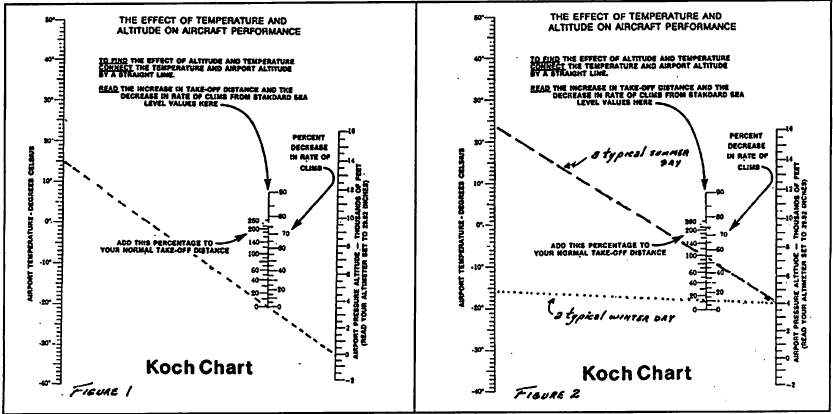
Using Figure 2 again, lets contrast the typical summer’s day with a typical winter’s day. The dotted line connects the same 4000 foot airport elevation with a temperature of -15C. Note that In this case, we show hardly any degradation of performance. This explains why your machine positively wants to leap into the air when winter flying. It’s GREATI The Rate of Climb is rocket-like.
Other factors also need to be considered. In the summer, the airfield you’re using might be soft or grassy which will further degrade the takeoff roll. In the winter, the same runway is likely frozen hard and enhances your take-off. The direction and velocity of the wind is also a major factor and one which we intuitively consider, regardless of density altitude.
Another thing to think about besides the Rate of Climb, is the Angle of Climb. Your Angle of Climb will also suffer at high-density altitudes. Because the air Is less dense, your true speed Is higher. If your forward speed is higher you will cover more distance across the ground, per foot of vertical climb, consequently, the Angle of Climb decreases. As a rule of thumb, your airspeed increases 2% for each 1000-foot increase in altitude above standard conditions. For example, at 4000 feet ASL, the airspeed indicator showing 50 mph could be corrected by 8%, to give an actual airspeed of 50+8% which equals 54mph.
In summary, the denser (colder) the air, the better the performance at a given altitude. Or conversely, the lower the airport elevation, the better the performance at a given temperature.
The causes of the decreased performance at the high density altitudes are normally described as being:
- Decreased engine efficiency, especially without any form of mixture control. You cannot lean-out your engine so It runs richer at high-density altitudes, and is therefore not putting out maximum power.
- Propeller efficiency-decreases in the thin air
- Airfoil efficiency decreases: to get the same lift you wlll have to fly at higher angles of attack.
Because density altitude affects the performance so much, I have included a “wallet-sized” version In Figure 3. Cut it out and paste it Into your logbook or whatever. Remember to check It from time to time, especially if you’re feeling really hot under that helmet and want to get airborne quickly to cool off.
While It’s true that the manufacturer usually quotes his performance data relative to standard conditions, a good safety rule to follow would be to calibrate these specs for you and your conditions…le temperature. pressure, runway conditions, winds and pilot skill.
 Calgary Recreational Flying Club YYC