

In last month’s newsletter, I reviewed the licensing, installation, and basic sources of info to learn about radio, specifically, VHF aircraft radio. The primary reason for considering radio is communication. Two-way radio allows for getting clearances, instructions, messages, and acknowledgments. But it’s likely few (if any) of us will want (or get) to fly into controlled airports. So why radio?
One major reason would be to announce your intentions at uncontrolled airports, which more of us frequent. To this you could add receiving the ATIS, enroute weather and emergency measures. Beyond this, the reasons get pretty weak; still, it might give you some peace of mind to monitor the traffic at some area or have the ability to talk to a fellow pilot to indicate your intentions. It all comes down to weighing the cost of a radio versus the benefits. Radio is not for everyone.
There are a lot of sound reasons for not getting into radio. For example, you have no desire to get into or near controlled airports; or the uncontrolled airports you frequent have little traffic and most of it is NORDO; or the weather you take off in is the weather you land in; or the additional weight penalty, cost and maintenance requirements are too much; or hearing all the chatter on the airwaves is too distracting.
I’m not sure where the balance lies. There seems to be good reasons both for and against. I think it boi1s down to a personal decision based on the kind of flying you do and the areas you fly around, into or under. We need to consider our motives carefully before buying the latest gadget.
This month’s article is directed at those who want to get into radio. How to use it? When to use it? Why use it? Properly!
For those not interested in radio, this article contains some good info on control zones in the Calgary area and basic rules of the air.
Figure 1 is a map showing the VFR terminal procedures to get into and out of Calgary. I’m not suggesting that you want to get into YYC; I doubt you’d get permission. Besides, I think we should keep a low profile. The reason for Figure 1 is to show the control zones and recommended traffic routes in the area. Knowing where and how the big machines enter/exit the Calgary area is good information. Forewarned is forearmed. Study Figure 1 and take a mental picture. Note the Bow River corridor between Calgary and Springbank. There is a lot of east-west traffic through there. Note the words in the upper right-hand corner. Inbound flights at 5,000 feet ASL and outbound flights at 5,500 feet ASL. A 500-foot separation. If you are considering flying north-south through the narrow space between the Calgary and Springbank control zones at 1,000 to 1,500 feet AGL, I’d recommend keeping a sharp lookout for traffic at the 3 and 9 o’clock positions. A mid-air broadside can ruin your whole day!
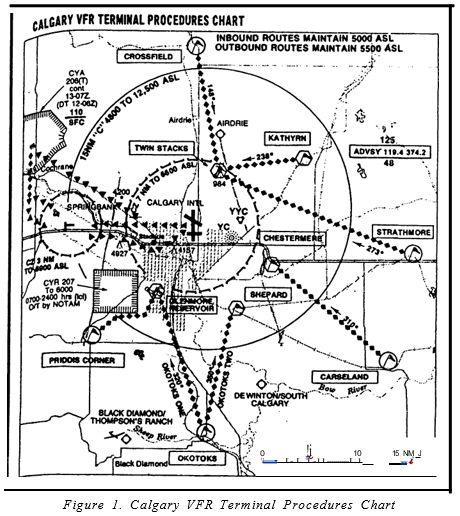
Also note the outbound arrows to the northwest practice area which straddles Highway 22. It might be a good idea to alert Sringbank tower that you are travelling through these areas. Close to Springbank, most aircraft are on Springbank frequency and will also hear you, and/or be notified by the tower. It is a good idea to sit up a bit and open your eyes another F-stop around control zones.
Another thing to note on Figure 1 is the “outer control zone” centered on Calgary. The radius is 15 nautical miles and it’s base is 4,800 feet ASL. “Never fly this high”, you say? Well, there are several transmission towers extending to 5,000 feet and ground elevations on the west side of the city exceed 4,000 feet. The point is, sometimes you might find yourself in this zone. A good strong updraft can boot you up to 4,800 feet ASL quite easily. There is something unsettling about “going up” in an updraft that’s not in your plan. Maybe we all have an umbilical cord to earth that we fear has been severed. Glider pilots get a different kind of rush out of this – their umbilical cords must be longer.
Rules of the Air
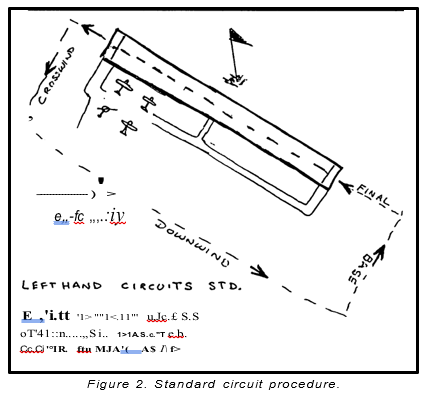
Before we can talk about the proper use of radios, a basic review of the circuit procedures seems timely. Figure 2 shows the basic circuit. The rules of the air (unless otherwise directed) for circuits are:
1) flown at 1,000 feet AGL 2) left hand 3) entry is made into downwind leg.
This accepted procedure is designed to maximize safety. You get a chance to observe other traffic, and since all aircraft are moving around in the same direction, the closing speed between aircraft is minimal. Doing the circuit any other way will be sure to create havoc and cause some interesting collision avoidance maneuvers. A good way to feel about three microns high would be to fly the circuit haphazardly, and then, when you land, listen to the other pilots lay some descriptive adjectives and verbs on you.
Aircraft with two-way radio should announce their intentions well outside the control zone – at uncontrolled airports about five miles out. Other traffic in the area is then alerted to your intentions and will look out for you. Beware, though, of the NORDO aircraft. Don’t fall into the trap that just because you have a radio, all others do. A good practice might be to fly as if everyone else is NORDO.
To communicate effectively, two-way radio has some conventions that should be understood. The message received that’s different from the message sent is potentially dangerous. Your radio operator’s handbook tells you that there are four parts to a message: the initial call, the reply, the message and the acknowledgement. This is true for the order of the message. For the content of the message there are also four parts. Here’s how I remember the four parts: 1) who you are 2) who you are calling 3) where you are 4) what your intentions are
Many pilots forget one of these four parts. Think before you transmit. With a little listening and practice, that’s all there is to it, whether you are talking to a controller or transmitting blind to an uncontrolled airport.
At uncontrolled airports, no controller exists. There may or may not be a UNICOM station. These airports may have a mandatory frequency (MF) or Aerodrome Traffic Frequency (ATF) assigned by Transport Canada. The purpose of this designated frequency is so that all radio-equipped aircraft opera ting on the ground or within a specified radius (ATF area) listen and transmit on a common frequency and follow a common reporting procedure. The Canadian Flight Supplement (CFS) lists all such airports, including all the necessary info. I’ve included a page (Figure 3) from this supplement that explains the situation in more detail.
Some typical conversations are reprinted below. These will give you some idea of the order and content of messages.
Typical Transmission at Uncontrolled Airports
Pilot: Okotoks traffic, this is ultralight India Alpha Bravo Charlie, five south at 5000 inbound for landing. (and a few minutes later – after monitoring the frequency, observing traffic and determining which is the active runway:)
Pilot: Okotoks traffic, this is ultralight India Alpha Bravo Charlie, joining downwind for one six.
The pilot then simply keeps a sharp lookout (for NORDO and radio aircraft) and lands.
At Controlled Airports
(assuming your have prior permission) Pilot: Springbank tower, this is ultralight India Alpha Bravo Charlie ten north at 5000 inbound for landing with information kilo.
(note the initial call is made outside the control zone)
Pilot: Springbank tower, this is ultralight India Alpha Bravo Charlie ten north at 5000 inbound for landing with information kilo (note the initial call is made outside the control zones)
Tower: Alpha Bravo Charlie, maintain 5000 following Highway 22. Report over Bow, watch for hang glider activity Cochrane Hill.
Pilot: Alpha Bravo Charile:
(a few minutes later)
Pilot: Springbank tower, Alpha Bravo Charlie over Bow.
Tower: Alpha Bravo Charlie, continue inbound following first set of powerlines to join downwind two five. Follow the 172 just turning downwind.
Pilot: Alpha Bravo Charlie.
Pilot: Alpha Bravo Charlie in the downwind for two five.
Tower: Alpha Bravo Charlie, number three, report traffic.
Pilot: Alpha Bravo Charlie has the traffic.
Tower: Alpha Bravo Charie cleared to land.
Pilot: Alpha Bravo Charlie.
Note how the pilot responded to air traffic directions and clearances. You must acknowledge clearances. The best way to learn the lingo is to listen in to conversations, to hear how to receive and acknowledge clearances.
Say Again
Here are some final tips for proper radio procedure and discipline:
- Prepare frequencies, etc.). ahead (know the traffic patterns
- Think before transmitting (compose your message).
- Listen in on the frequency to get an idea of what’s going on before transmitting.
- Don’t step on other transmissions or interrupt a sequence between others.
- Don’t clip your transmissions (i.e. key the mike before you begin to speak).
- Use phonetics phraseology correctly.
- Be brief.
- Speak clearly and concisely.
- Acknowledge all clearances and instructions.
- Do not transmit in unauthorized fashion (profanity, etc.).
Fly safe.
 Calgary Recreational Flying Club YYC