
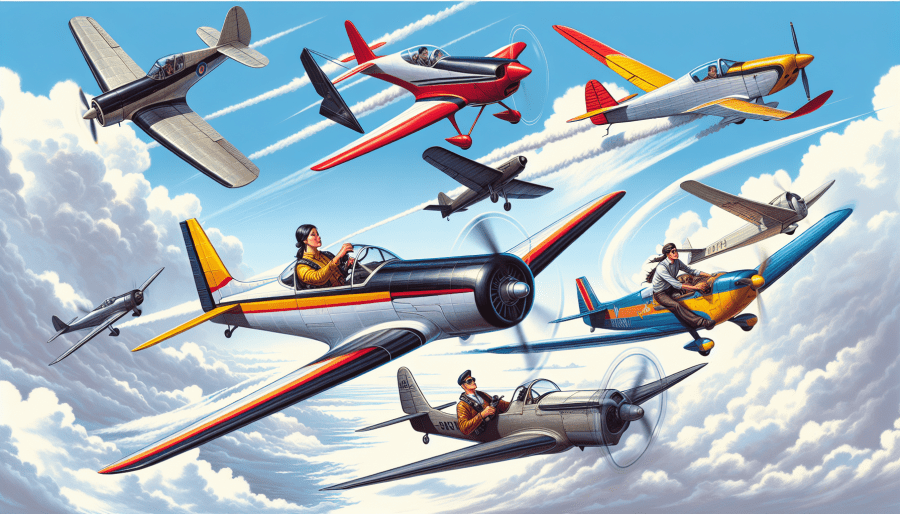
You have a distinctive flying style. What it is, and how you got it is a function of a number of variables. Your friends can probably describe your style better than you can. Style has something to do with looking from the outside, not the inside. It’s a quirk of human nature that we are better at passing judgment on someone else’s style than examining our own.
One day, I was watching a bunch of similar aircraft doing circuits. It occurred to me that I could identify the various aircraft by the “style” of each pilot, long before any registration marks or colours were visible. Some turned final close in and slipped off altitude while others made a long, low-angled approach, jockeying with the throttle. Some came hot and wheel landed; some three-pointed at the threshold. Each pilot’s style was as distinctive as his signature. I wondered how this could be? I got to thinking about flying styles and concluded that it’s a complex subject. Still, it seemed worth writing about.
Flying style is an important element of safety. Style seems to be an attitude, an approach, and a methodology to carrying out some task. Let’s consider these one at a time.
Style – an Attitude
Your style is partly the result of your attitude. The link between out attitude and the aircraft’s attitude might seem hazy but I’ll try to remove the fog and clouds. The degree of respect for the air and air machines is instilled at an early stage of our training. This is the time when we learn the basics of self-discipline and professionalism. Instructors instill this more by example than by preaching it. Unfortunately, not all instructors are good role models, nor do all students come with learning attitudes. The respect for authority, rules and guidelines was likely formulated a lot earlier in life and was carried into the initial training.
The stamp of our attitude towards flying, plays a large role in determining how we fly. The risks we take … or don’t take. The exercises we repeat are instilled in the subconscious as acceptable practices – whether they are or not. The habit of doing it is reinforced with every repetition. It’s a hard pattern to break. Instructors and students need to watch closely for bad practices – to catch them and break then before they become instilled. Our attitude towards accepting constructive criticism at this stage needs to be open-minded. No one likes to be told they need an attitude adjustment. One of the duties of an instructor is to recognize a potentially destructive attitude in his students and remedy it. With all the different personalities involved, instructors have a big task in handling the matter, to get the desired results. From time-to-time, I check my own attitude for deficiencies. Simply answer the question: Is what I’m doing, or going to do, a good idea? What would I think if my friends had this attitude? If the answer doesn’t fall within your threshold for safe practices, then reconsider it. A large part of safe flying recognizing our attitude towards situations and taking the correct course of action by making the right decisions, and the decisions right.
Style – an Approach
Style has a lot to do with how we go about doing things. We can tell a lot about a person by the way he goes about preparing to do some task. For example, take an accomplished downhill skier. Watch him as he prepares. He comes out of the lodge walking with confidence and in a relaxed manner, even with clumsy ski boots. He approaches his skis with authority and economy of motion. He’s done this hundreds of times and a pattern has set in. No wasted moments go by. The skis are put on in less than 30 seconds, poles are in hand and mind on the next step. Just watching him, before he even takes a stride, you know that he can handle almost anything.
Observe an accomplished pilot doing his preflight. You can tell his skill level by his actions. He, too, approaches his aircraft with confidence and authority. No wasted moments. He always starts in the same place and goes over everything carefully, double-checking the most critical areas. His mind is on the task at hand and few side conversations are allowed to interrupt his thoughts. He knows what he is r– about to do and how to do it in the most effective manner. The manner in which we do things speaks loudly of our style. Whether it’s our style of taxiing, how we take off or land, or how we handle in-flight tasks, the approach to the problem tells a lot about our experience and competence.
Style – a Methodology
Any consideration of style must deal with the element of physical co-ordination or how we execute the task. Each of us develops a unique style with co-ordination skills. For example, how many times have you been able to identify a person at a distance by his walk or mannerisms, or maybe recognize a distant skier by his style, long before any details of his appearance come into view?
We all develop our own style in coordination. Coordination of mind and body comes together in the actual execution of a task. Consider the driving of a car. We all develop a recognizable style. After many hours at the wheel, we began to drive “unconsciously”. Intellectually and subconsciously we know what must be done and the many ways of doing it. Looking ahead, backwards and sideways, coordinating our hands and feet, we make the minute corrections to the left of right. Everyone does them differently, according to his style.
With an aircraft, there is more freedom of axis, i.e., left/right, up/down, and bank (yaw, roll, and pitch), as well as speed. It’s no wonder we develop our own style with so many degrees of freedom. The pilot is controlling his machine in his own way and, since it’s an extension of himself, it’s natural that his “style” is overprinted on the aircraft.
Don’t confuse style with ability. Many styles are acceptable, usable, and functional; some are more functional than others – it depends on the conditions. Our styles should change with the conditions. A style that is safe for one set of conditions may be unsafe under other conditions. An appropriate landing method under calm winds is not appropriate for cross winds. An appropriate climb-out rate or speed in calm conditions is inappropriate under gusty conditions.
Style is an important element of safety. The way we think about things contributes to our style. What’s your style? Does it change with the conditions? You’re always in style when safety is considered first.
Fly safe?
 Calgary Recreational Flying Club YYC