
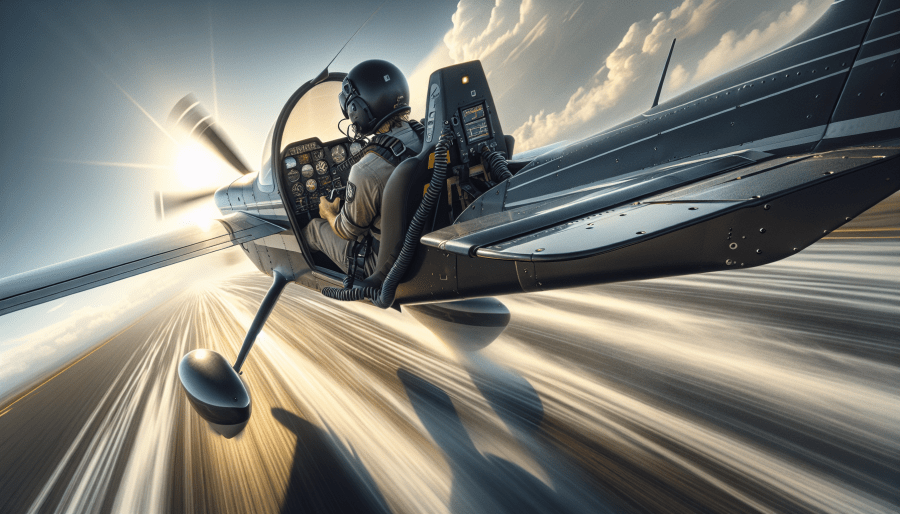
In the last newsletter I promised to give you a report on what it’s like to fly the Renegade Spirit. Fasten you seat belt?
I had flown a Renegade once before, at the factory, which was almost a year before mine took flight. So that didn’t count. After Robin Dyck, Murphy’s test pilot, completed the initial test flight I was able to get in two short circuits with him before he had to go. They were Short because my engine started overheating after about 3 or 4 minutes in the air. I later solved the overheating problem by changing the radiator and making a number of modifications to the engine cowling. So about two weeks after my two short dual flights it was time to go solo.
Taxiing the Renegade requires some getting used-to for a trike pilot like myself. Solo flight is from the back seat, which means zero forward visibility over the cowling. Watching that huge 68″ prop swinging around the nose immediately instills a fear of striking an unseen fence post, a dim-witted dog that might be on the runway, or worst of all a person. So the first order of business it to learn how to taxi by snaking down the runway doing mild s-turns with one’s head bobbing from side to side to maintain visibility.
After making my way to the end of the runway in this manner, I now discover what it’s like to turn an airplane with the center of gravity behind the main gear. At first my turns have a very wide radius because I’m being very cautious with the power (I’ve read the articles about how easy it is to ground-loop a taildragger). After a bit of practice, however, I’ve found that the turning radius can be greatly reduced by careful control of the power input and rudder. It soon becomes easy to sense when the tail is getting ready to take over and start accelerating your turn. As long as you remain below that critical speed you are in control of your turn; above it and the airplane takes over. The centrifugal force, acting on the C of G, actually accelerates your turn and whips the airplane around in much to same way we used to crack the whip on ice skates when we were kids.
We’re now ready to become airborne. Test the controls, one final zigzag to make sure the runway is clear, stick neutral, full power and we accelerate down the runway like a thoroughbred out of the gate. The tail gently lifts after only a few seconds and I’m using rudder only, to keep her on target. The tendency to wander off course is now more pronounced and attention to the rudder pedals dominates for the moment. Once the airspeed hits 50mph I start to pull back on the stick. The Renegade seems to jump from the runway and immediately feels completely at home. in the air. As the airspeed climbs to 70 I pull back more on the stick, expecting it to drop back to about 50. Instead she streaks skyward at an angle of attack I’ve never experienced before, all the time maintaining 60mph. After scaring myself, expecting a tailslide any moment, I level off, cut my power back and try to get my bearings. Full power on the 532 registered about 6500 on my tach. Now I’m cruising at 5600 and 75mph.
Now its time to get used to the controls. Without the second person in the front seat the airplane is extremely sensitive to all inputs. Initially I felt it was too sensitive, but like anything, once one gets used to it the word sensitivity is replaced by responsiveness. I’m used to throwing the slick full stop to bank and counting the seconds to 45 degrees.. In the Renegade a slight twitch is all that is necessary to enter a gentle turn. No possibility of getting bruised knees from moving the stick back and forth in rough weather. I installed the elevator trim option and it turned out to be very useful. With two she flies level at 75mph and neutral trim, but solo nose-down trim is required to relieve the forward pressure on the stick. Yaw sensitivity is very much there. Fortunately, the rudder is very responsive since constant rudder input are required to maintain coordinated turns and control yaw whenever engine power is changed. Not that its particularly difficult to keep the tail behind you, but compared to what I’ve been used to it yaws on a dime.
In level flight, you can see quite well over the nose. The horizon is about 2 degrees above the cowling. The upper wings provide a permanent sun visor but because they are in front of the rear cockpit, upward visibility is fairly good. Downward visibility, on the other hand, is limited. The cockpit is directly over the bottom wings, so you cannot see what is directly under the airplane. If you really want to see what’s there, a quick roll from side to side will provide a momentary full view. Instruments in the front and rear cockpits are equally visible. I laid them out so that critical instruments are in the rear in case someone is in the front blocking the view. I installed ASI, Tach, Altimeter, and water temperature in the rear cockpit and a second ASI, VSI, slip indicator, CHT, Hobbs meter, and volt meter in the front cockpit.
Now that we’ve been cruising around for awhile its time to get back down. I found that it, took me about 5 hours in the Renegade, .alone, with about 10-15 landings before I felt -comfortable with my approaches and landings. I’ve tried conventional, high attitude, power on approaches (4 foot with occasional side slips to view the runway and ultalight-style nose down, low power approaches. I prefer the latter. For one thing runway visibility is much better. Initially I came in much too hot, expecting to lose speed quickly after round out. This was not the case, I had to get used to the fact that I was flying a much heavier and cleaner airplane which took much longer to bleed off speed. Once I got my mind around that I was able to get the wheels on the ground much sooner with fewer bounces. Doing a three-point landing turns out not to be too difficult. The Renegade seems to naturally assume the correct angle of attack as it stalls in, touching with three wheels. I have yet to try a significant cross-wind landing, however. This may require some practice?
Now that I am feeling at home in the Renegade, I am absolutely delighted with the way it flies. I am looking forward to some cross country flights to visit some of you that have your own fields.
I hope you have enjoyed reading about me and my Renegade. It has certainly been a great experience for me.
 Calgary Recreational Flying Club YYC